
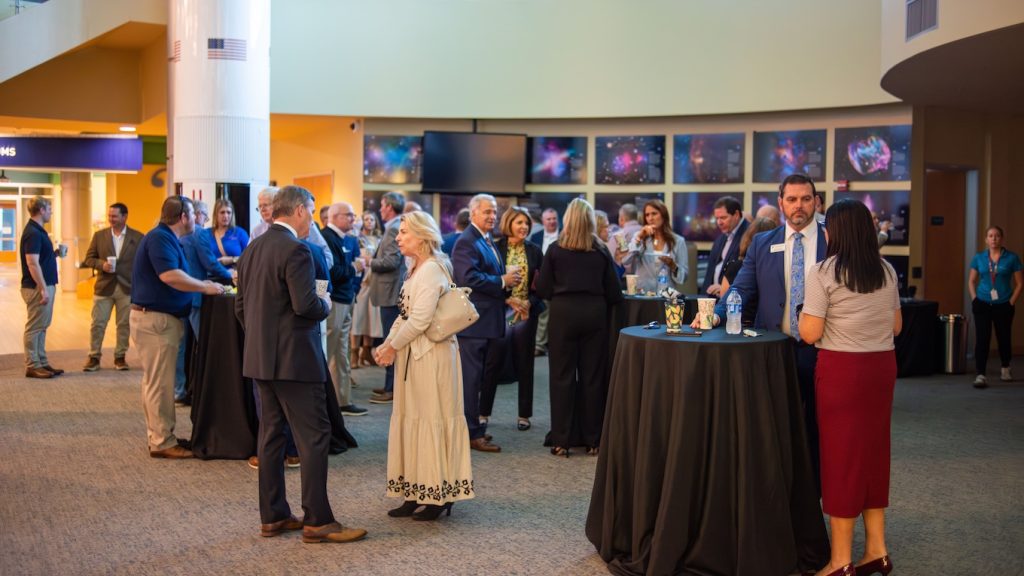
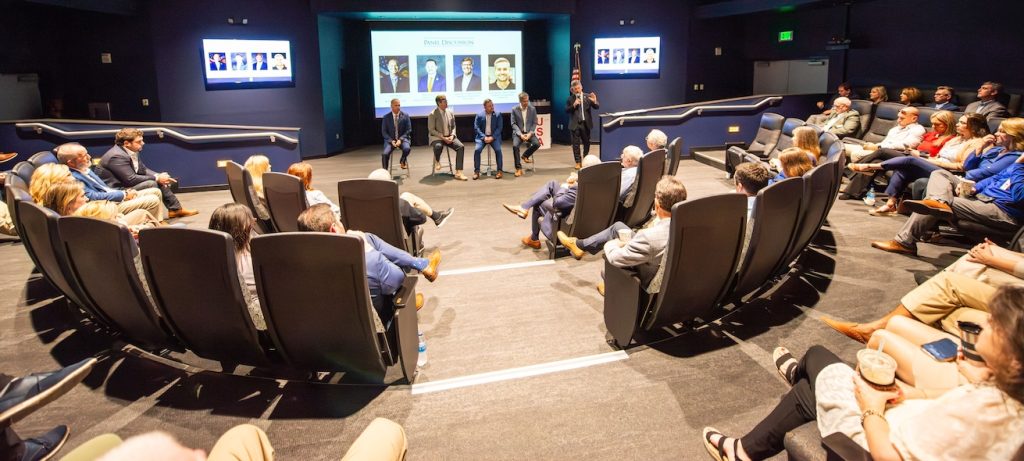
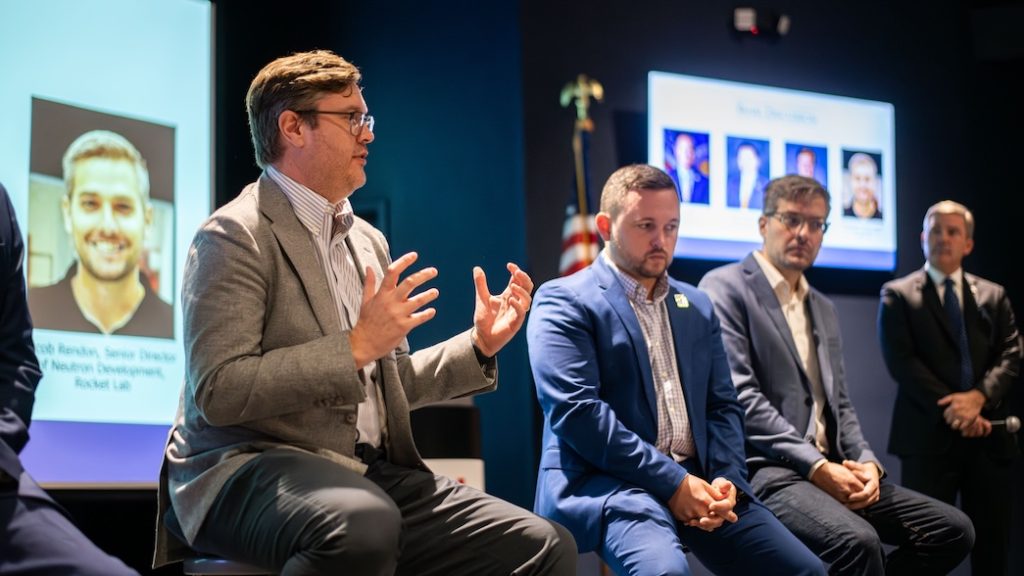
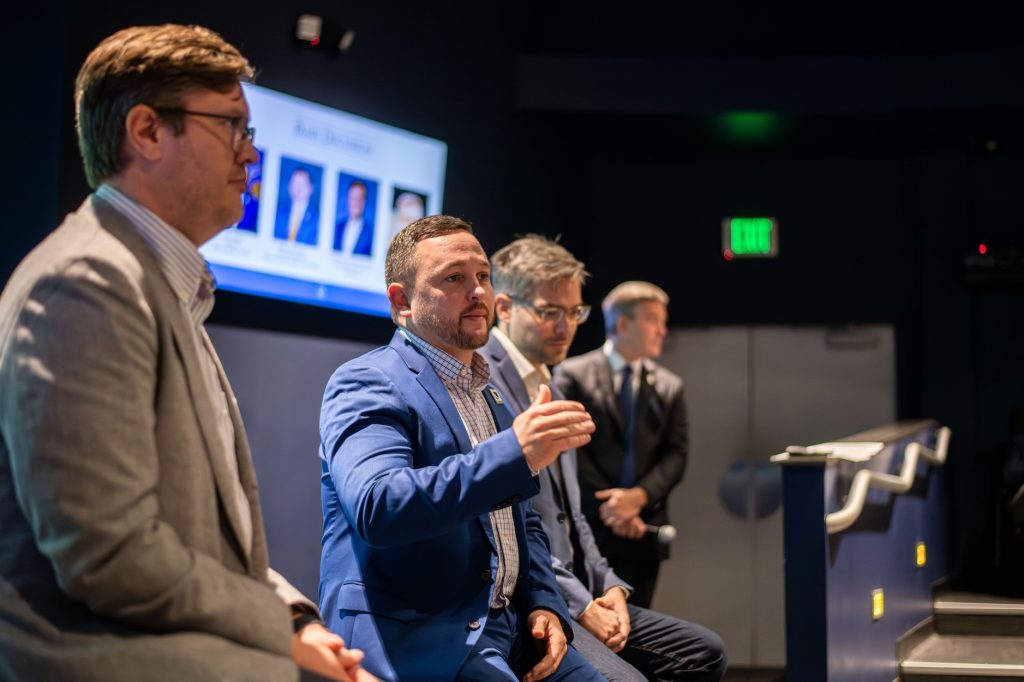
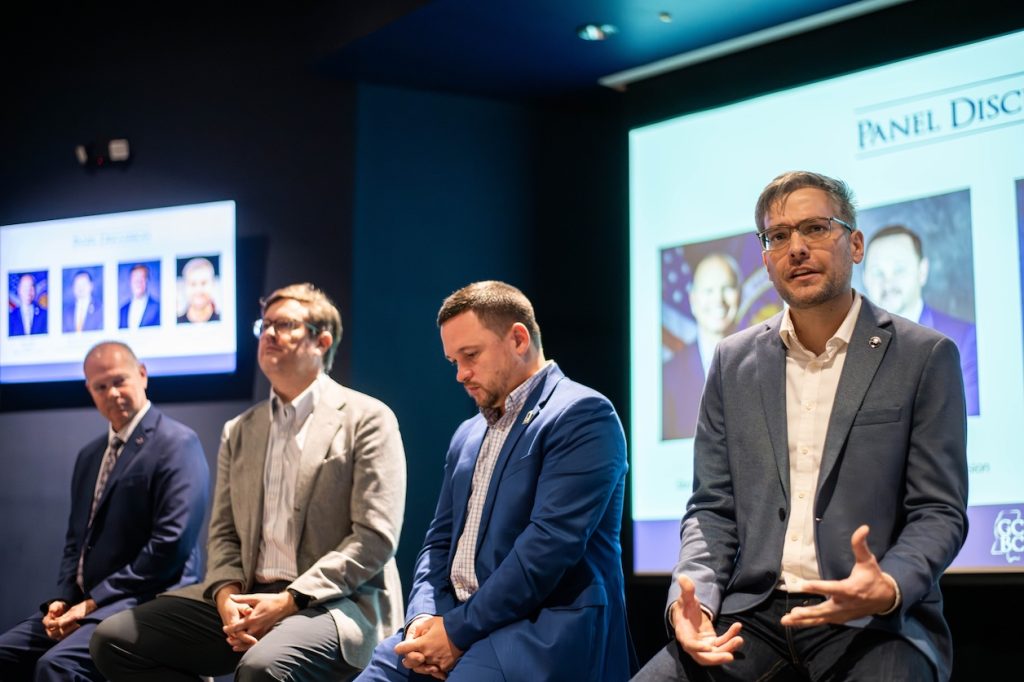
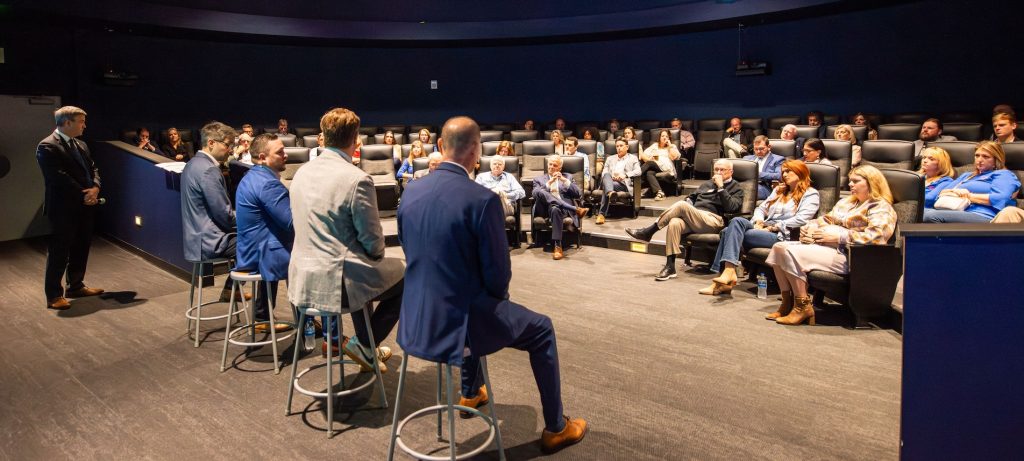
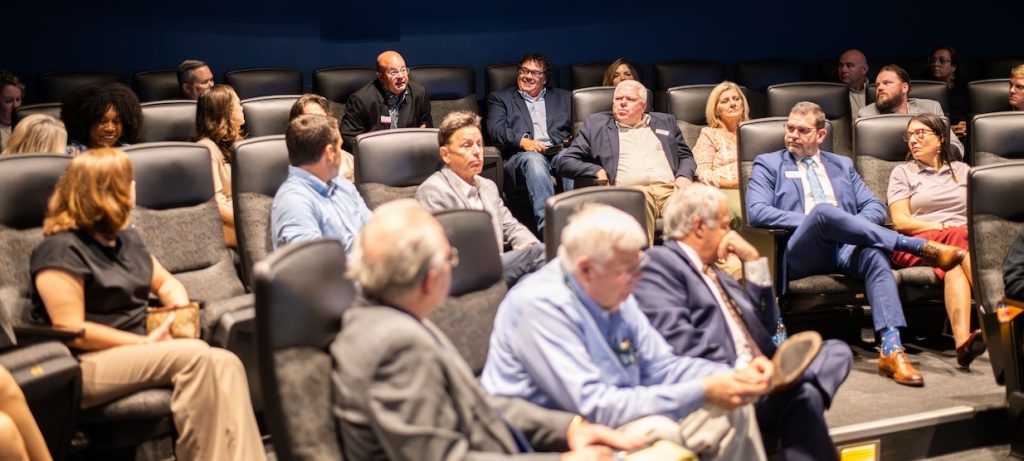
The Gulf Coast Business Council closed out its 2025 general membership meetings at a fitting venue for forward-looking conversation: Infinity Science Center at Stennis Space Center. Members and guests gathered on Friday, November 21, for a panel discussion that brought together federal, state, local, and industry leaders to talk about innovation, infrastructure, and investment on the Mississippi Gulf Coast.
We extend our sincere thanks to Infinity Science Center for hosting us and opening the museum for attendees to explore following the meeting.
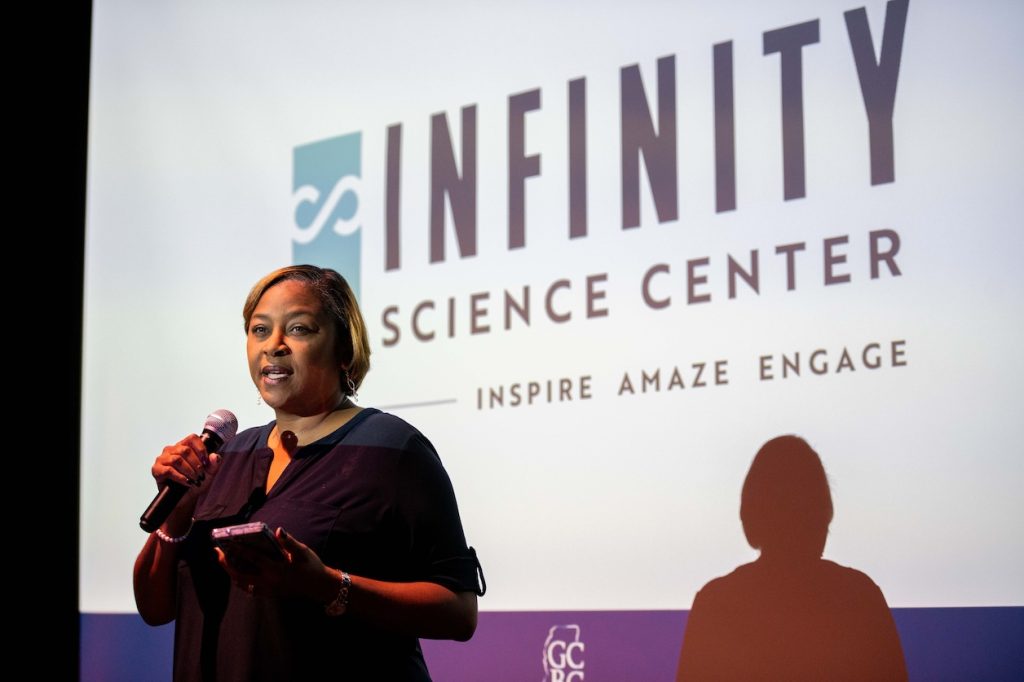
Gulf Coast Restoration Fund: A More Strategic Approach
Before the panel began, GCBC President & CEO Jamie Miller provided an update on the Gulf Coast Restoration Fund (GCRF), highlighting a more disciplined and data-informed process for project recommendations this year.
In past years, the advisory board often forwarded a long, unordered list of projects totaling far more than the available funds, which did not simplify the guidance provided to the Mississippi Development Authority (MDA). This year, the board first narrowed the pool to projects that were economically viable, durable, and likely to generate measurable impact. Each advisory board member then independently ranked their top projects.
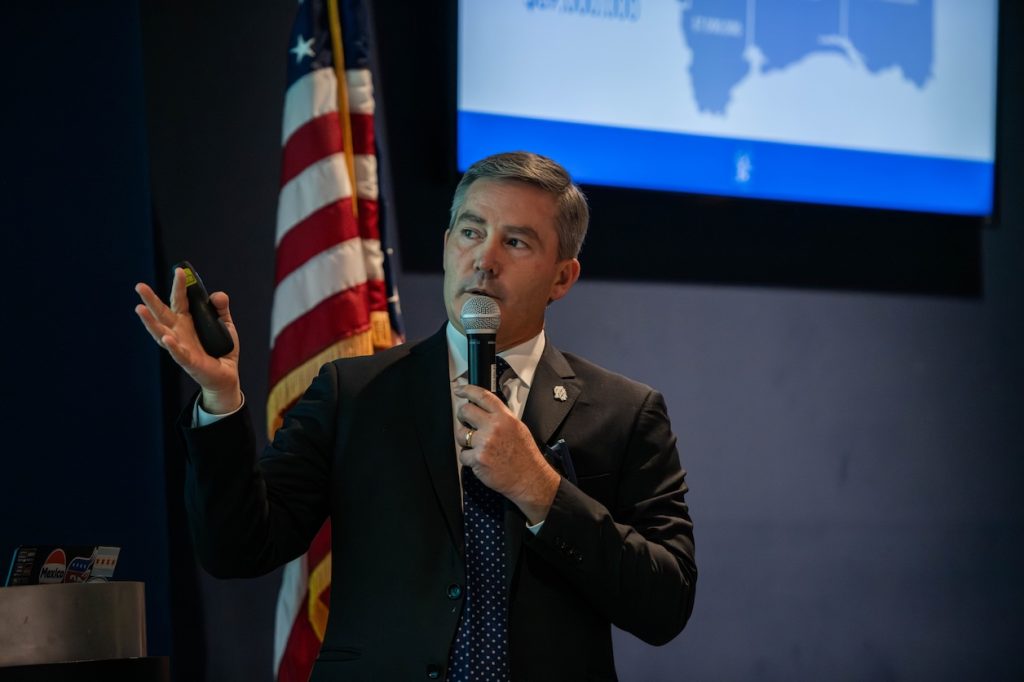 With approximately $69 million available for 2025, the board only recommended projects that, in total, remained within that cap. Many projects also received a reduction from their original request amounts to “right-size” the public to private dollars being leveraged to fund projects. The top-ranked project on the list was the Gulfport-Biloxi Regional Airport’s extension of a second runway, to provide redundancy to the primary runway and add capacity for military and commercial flights at the airport.
The geographic distribution of the recommended projects reflects a balanced regional approach. The board also supported the concept of a revolving loan trust fund to be managed by a regional entity in South Mississippi, creating a tool that could be leveraged repeatedly over time rather than in one-time grants. In total, 16 projects were recommended throughout the six-county region.
As Miller noted, the signal from the advisory board to MDA and the Legislature is clearer this year: here is a ranked set of projects that fit within available funds and are expected to deliver long-term economic benefit. Ultimately, the Legislature will make final investment decisions when it convenes in January.
Federal Perspective: NASA Stennis Navigates a Turbulent Year
John Bailey, Director of Stennis Space Center, opened the panel with an overview of what has been an unusually challenging year at the federal level: a new administration, a yet-to-be-installed NASA administrator, appropriations delays, and a federal government shutdown.
Despite the uncertainty, Stennis maintained its momentum. Bailey described how the center worked to keep critical capabilities online for commercial and federal partners—even during the shutdown—so their testing schedules and time-to-market goals were not derailed. On one day during the shutdown transition, Stennis supported three separate rocket engine tests: Relativity Space in the morning, Rocket Lab in the afternoon, and an RS-25 engine test for NASA.
Bailey emphasized that NASA does not see companies like Rocket Lab, SpaceX, or Blue Origin as competitors, but as partners. Stennis’ role is to enable testing and innovation by providing world-class infrastructure, technical expertise, and a unique buffer zone that allows for intensive rocket testing without encroachment.
Looking ahead, Bailey pointed to policy and legal constraints as an area where change could unlock even more potential. Current appropriations law makes it difficult for NASA to accept direct commercial investment into certain shared infrastructure, even when it would benefit both the agency and its partners. NASA is exploring ways to modernize these rules so that companies can more easily invest in and upgrade facilities inside the federal footprint, allowing growth to keep pace with industry demand.
State Perspective: Leveraging Federal Investment Through MSET and the Aerospace & Defense Alliance
From the state level, Davis Pace, President & CEO of the Mississippi Enterprise for Technology (MSET), described his organization’s mission as straightforward but powerful: leverage federal investment in Mississippi—whether in facilities, research dollars, or technology—to create jobs.
MSET, a statutory office housed within the Mississippi Development Authority, serves as the state’s office of space and technology. Based at Stennis with an additional presence in Jackson, MSET connects federal labs, universities, and private industry to accelerate technology transfer, company growth, and job creation.
Pace highlighted the Aerospace and Defense Alliance of Mississippi (ADAM), a 501(c)(6) trade association created to convene industry, university, and federal partners. Through this alliance and the annual Mississippi Aerospace & Defense Symposium, MSET has seen rapidly growing interest in the state’s aerospace and defense ecosystem—from Starkville and Oxford to the Coast, even during this year’s government shutdown.
MSET is also working closely with MDA and the Mississippi Development Authority’s international efforts. For global events like the Paris Air Show and the Farnborough (London) Air Show, MSET now helps coordinate meetings and maximize Mississippi’s presence, ensuring that Stennis, the Coast, and the state’s aerospace and defense assets are clearly represented to international companies.
Local Perspective: Hancock County, National Defense, and Tomorrow’s Workforce
Blaine LaFontaine, Executive Director of the Hancock County Port & Harbor Commission, framed the local discussion around U.S. Senator Roger Wicker’s “21st Century Peace Through Strength” report, which calls for a generational reinvestment in America’s defense capabilities and a long-term goal of raising defense spending to approximately 5% of GDP.
For Hancock County and the broader Gulf Coast, this report is more than a policy document—it is a roadmap to align regional assets with national priorities. From unmanned systems and shipbuilding to munitions and advanced manufacturing, the Coast is well-positioned to capture new defense-related opportunities.
LaFontaine pointed to a couple of recent examples already bearing fruit:
- Nammo Mac LLC at Port Bienville receiving a major munitions contract to boost supply.
- Sky Dweller Aero at Stennis International Airport demonstrating that the region can support cutting-edge aerospace testing and operations with FAA waivers and a robust buffer zone.
To fully realize this potential, the region must continue investing in:
- Workforce: Aligning curricula at institutions like MGCCC, PRCC, and partners such as Accelerate Mississippi with the skills needed by aerospace and defense employers.
- Infrastructure and sites: Expanding hangar capacity, apron space, and “shovel-ready” sites at places like Stennis International Airport and Port Bienville.
One major milestone on that front is Ignition Park, a new development at Stennis International Airport designed to attract blue economy tech companies and defense contractors that need pad-ready sites, utilities, and room to grow. A ribbon cutting is planned for December 5 with Governor Reeves, reflecting how local, state, and federal partners are aligning around long-term site development.
Industry Perspective: Rocket Lab’s Next Chapter at Stennis
Representing the industry side, Jacob Rendon, Senior Director of Neutron Development at Rocket Lab, shared the company’s story and why Mississippi—and Stennis, specifically—was the right place to invest.
Founded in 2006 by Peter Beck, a machinist-turned-founder from New Zealand, Rocket Lab built its reputation on Electron, a small launch vehicle that offers dedicated rides to orbit for customers who need precise timing and placement. With more than 75 Electron launches completed and plans to increase cadence to 20–30 launches a year, Rocket Lab has become one of the most active private launch providers in the world.
Over time, the company vertically integrated into spacecraft production and key components like solar panels and flight software. Rocket Lab technology now powers missions ranging from commercial satellites to NASA programs, with its solar panels flying on platforms like the James Webb Space Telescope and the Ingenuity helicopter on Mars.
Neutron is Rocket Lab’s next step: a larger, fully reusable rocket designed to operate more like an aircraft—with rapid turnaround, retained fairings, and a core stage that returns to land or barge for reuse. To power Neutron, Rocket Lab needed a place to test its Archimedes engines at scale.
After evaluating sites around the world, Stennis emerged as the clear choice. Rendon cited several advantages:
- Decades of propulsion testing experience and a workforce that understands rocket operations.
- Established contractors and vendors who know how to build and maintain test stands and logistics systems.
- Shared infrastructure provided by NASA, including the gas house and support services.
- A purpose-built buffer zone that allows intensive, frequent testing without encroachment concerns.
Today, Rocket Lab runs two shifts a day at Stennis, testing from early morning to late at night—a testament to the capacity and capability of the site. Rendon shared that other parts of Rocket Lab’s business are now exploring the possibility of bringing additional propulsion work to Stennis, further deepening the company’s local footprint.
Shared Opportunities: Policy, Infrastructure, and Talent
In the final portion of the panel, speakers focused on what it will take to keep Stennis—and the broader Coast—at the forefront of aerospace, defense, and advanced manufacturing. Several themes emerged:
Policy modernization: From NASA’s ability to accept commercial investment in shared infrastructure to federal rules around development in and near the buffer zone, updated policies could help accelerate growth without compromising safety or mission needs.
Coordinated project packaging: Federal, state, local, and workforce partners are increasingly meeting with prospective companies as a unified team, presenting a “one-stop” view of sites, incentives, and talent. Maintaining and expanding this alignment will remain critical.
Workforce development: The region is producing strong engineers and technicians from universities and trade programs, and its existing oil-and-gas workforce translates well into aerospace and industrial roles. Panelists also pointed to the opportunity to build more aerospace-specific curriculum and hands-on test stand experience at local universities and colleges.
Marketing and storytelling: Stennis’ unique assets—its buffer zone, infrastructure, and test heritage—cannot be easily replicated elsewhere. Continually telling that story, nationally and internationally, will help attract additional investment and companies.
What’s Next
This November gathering at Infinity Science Center was GCBC’s final general membership meeting of 2025. There will be no December meeting, as attention turns to the 2026 legislative session.
The Mississippi Legislature convenes on January 6, and the annual Gulf Coast Legislative Reception in Jackson will take place on January 7. We encourage all members to attend as we continue advocating for policies and investments that strengthen Coastal Mississippi’s economy.
Thank you to our panelists, our hosts at Infinity Science Center, and all GCBC members who joined us for this important conversation about the future of Stennis, Hancock County, and the Mississippi Gulf Coast.
